The Black Reservoir
THIS IS A WORK OF FICTION
At dawn the reservoir behind the tram depot looked less like water than a hole somebody had forgotten to finish.
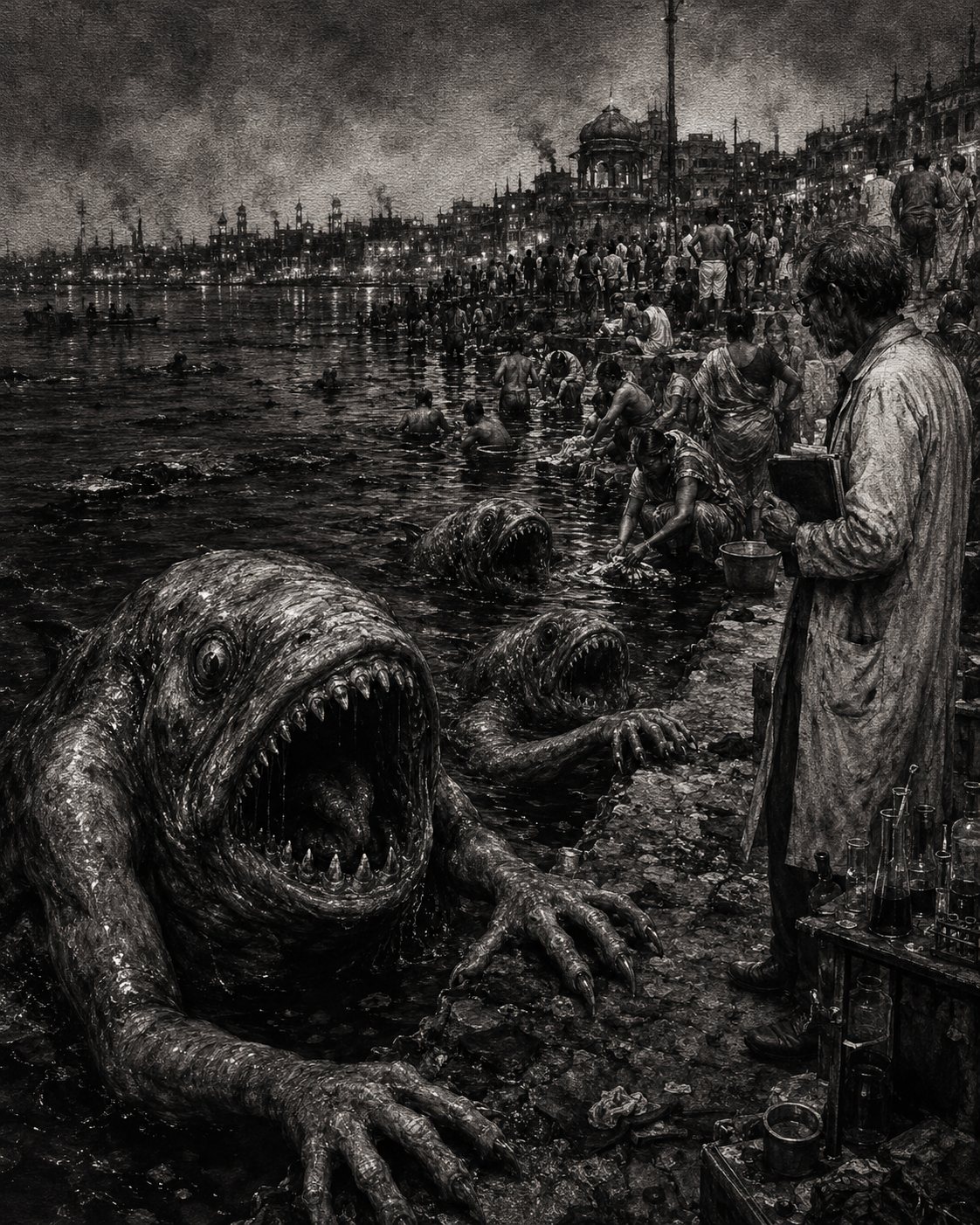
Buses coughed past the broken wall. Tea boiled in dented kettles on the pavement, thick with milk and suspicion. A man in a vest slapped newspaper cones around muri. Two washermen beat shirts against the ghat steps with the resigned violence of clerks stamping forms. Women came with brass pots, plastic buckets, steel bowls of marigold and bel leaves. A priest in a damp dhoti stood knee-deep at the edge, asking the gods to please accept what even the municipality had refused.
The water accepted everything.
Flowers. Ash. Gutkha sachets. Goat blood after festival mornings. Broken toys. Cheap shampoo foam. Rainwater from lanes where drains had not worked since one government blamed the previous government and then became indistinguishable from it. The reservoir swallowed it all and shone blackly under the early sun, patient as a magistrate.
Dr. Nirmal Chatterjee watched from behind a curtain of bougainvillea that had gone dusty and mean.
He was sixty-two, though grief and grant applications had made him look like an underfunded seventy. Once he had lectured at conferences on adaptive respiration in freshwater species. Now he lived alone in two rooms above a shuttered sweet shop in Chetla and spent his mornings carrying covered buckets to a place where nobody asked questions before eight.
A fish broke the surface.
Not jumped. Reached.
A pale shape pressed upward below the black skin of the water. Four thin fingers, webbed like wet muslin, opened against the morning, then closed. The washerman, Haru, looked up from a bedsheet.
“Again,” he said.
Nirmal stepped back behind the wall.
Haru saw him anyway. Calcutta had no private corners, only public corners where people were polite enough to pretend blindness until useful.
“Doctorbabu,” Haru called. “Your children are doing circus.”
“They are fish,” Nirmal said.
“That is what I am saying. Your fish are doing circus.”
The fingers vanished. A bubble came up, round and oily, and burst with a smell of drain, old eggs, and something sweetly animal.
Nirmal carried his bucket down the broken steps. He wore old leather shoes, absurd for mud, but he had always believed danger should be met properly dressed. Inside the bucket, six black pellets shifted against the tin.
Haru wrung the bedsheet. “You will put more food?”
“Enzymatic starter.”
“Food with English degree.”
“It helps them metabolize hydrocarbons.”
“Then give some to my brother-in-law also. He eats kerosene in political meetings.”
Nirmal did not smile. He had liked Haru once for this exact style of nonsense, the Bengali municipal genius for turning catastrophe into tea-stall material. Lately even jokes seemed like small stones thrown at glass.
He scattered the pellets.
The water stirred.
Not one fish. Not six. Dozens.
Their backs moved just below the surface, glossy and ridged, mottled green-black like damp walls. They had begun as ordinary enough things in the laboratory: catfish, murrel, mudskipper, lungfish sequences coaxed into practical cooperation; a creature designed to eat oil film, digest plasticizers, bind heavy metals into bony nodules, and survive the urban insult that was Calcutta water. Nirmal had called them Nalini stock after his wife, because grief, like science, becomes foolish when left unsupervised.
They had cleaned the reservoir. That was the first miracle.
The stench had thinned. Mosquito larvae vanished. The floating scum retreated from the ghats. For three weeks the water had looked almost brown instead of black, and the local councillor had come with two photographers and a stomach full of credit. He had stood beside the railing and announced a pilot ecological restoration initiative, though the only initiative he had shown previously was in moving funds from one folder to another.
Then the fish grew lungs.
Nirmal told himself lungs were expected. Not lungs exactly, but gas exchange sacs. Primitive. Useful. He had designed tolerance, not ambition.
Then came the hands.
At first they were only thickened fins. Then wrists. Then fingers. The fingers had nails like translucent seeds.
The day before, a child had dropped a biscuit on the last step. A fish had climbed out, taken it, and sat in the slime chewing.
Sat.
There were verbs in science that ruined sleep.
“You should inform somebody,” Haru said, softer now.
“I have informed.”
“You informed yourself?”
Nirmal looked at him.
Haru lowered his voice. “Listen, Doctorbabu. Yesterday evening one fish came till that crack. Not small one. Belly like a baby. It made a sound.”
“Fish make sounds.”
“It said Ma.”
“That was air escaping the throat.”
“Air escaping the throat says Ma now? Very educated air.”
Nirmal closed the bucket. Across the reservoir, a woman in a red nightie rinsed a steel plate, her bangles clacking. Her little boy squatted beside her, pushing a toy bus along the wet step. The child never looked at the water.
Nobody looked down in this city if they could help it. Down there were bills, drains, beggars, rats, loose wires, the old parents nobody could place, the unemployed sons with English-medium accents, the daughters returning after failed marriages, the quiet fact that middle-class dignity had become a borrowed shirt worn carefully to hide the tear under the arm.
“Nobody comes here after dark,” Nirmal said.
Haru laughed once. “You are joking or making rule?”
Nirmal did not answer.
The first missing person was not counted.
Old Manik, who slept under the tram shed awning, was absent for two days. People said he had gone to his niece in Barasat, though Manik had no niece and had once cursed Barasat for reasons nobody remembered. A dog nosed his blanket, then refused to sleep on it.
The second was a goat.
That counted, because it belonged to someone.
By noon a quarrel had formed beside the ghat. Goat ownership, unlike human loneliness, had paperwork in the form of witnesses. Haru sent a boy to fetch Nirmal, who was in his lab room above the sweet shop, staring at a glass jar where a juvenile specimen floated in cloudy formalin.
The creature was no longer than his palm. Its little hands were folded against its chest, almost modest. Along its neck ran slits, and below them a swelling of rudimentary lung tissue. Its mouth was too wide. That had bothered him more than the hands.
He had found it dead near the sluice gate with a brass nose ring in its gut.
Nalini had worn a nose ring when they married. This was not hers. Of course not. Hers had gone with the body to the crematorium, and he had stood there like furniture while flame ate the only person who had ever told him when he was being pompous.
Still, he had dreamed of her the previous night, standing waist-deep in black water, saying, “You always feed what you cannot face.”
At the ghat the goat’s rope remained tied to a pole. The other end disappeared into the reservoir, pulled tight.
“See?” said the owner, a woman named Bina who sold flowers outside the Kali temple. “Something dragged him. My Lakhan was not foolish goat. More sense than my husband.”
The husband, present and unwisely sober, said nothing.
Nirmal touched the rope. Fibers had been cut cleanly, not bitten. He crouched, ignoring the pull in his knees. On the wet step beside the rope were prints. Five narrow marks. A palm. Another palm.
Child-sized.
But too many.
They went up three steps and back down.
“Some boy did this,” Nirmal said.
Bina stared at him. “Which boy has six hands?”
The crowd leaned in. Calcutta crowds did not gather; they condensed. By the time one person said “ki holo,” ten others had arrived with opinions, moral positions, and digestive complaints.
The councillor’s assistant, a young man with hair shaped like a helmet, pushed through. “Nothing happened. One goat fell. Why create panic?”
“It was pulled,” Bina said.
“It was an old goat.”
“It was three years old!”
“In modern pollution, that is old.”
Nirmal stood. “Close the ghat for a few days.”
The assistant smiled as though Nirmal had asked him to close the Howrah Bridge for emotional repairs. “People need water access. Ritual access. Washing access. Election access also, Doctorbabu. You scientists make one fish and think society will rearrange.”
“I am telling you there is risk.”
“You told us these fish are safe.”
Nirmal felt the crowd turn. Not angrily yet. Worse. Curiously.
“I said the trial required containment.”
“You released them.”
“The sluice leak—”
“You released them,” the assistant said again, because repetition was the cheapest form of truth in public life.
Haru watched Nirmal. There was disappointment in his eyes, and fear behind it.
Nirmal had released them. Not officially. Not properly. Not after approvals, containment tests, ecological modeling, public hearings, and the thousand dusty rituals by which responsibility was slowly distributed until nobody had any left. He had released twelve fingerlings during a storm when the reservoir had foamed white and dead fish floated belly-up by the dozens. He had thought of Nalini gasping in the cancer ward when the oxygen line failed during a power cut and the nurse said, “What can we do, sir, this is India,” as if the country were weather.
He had wanted one thing to work.
That was his hiding place: not pride, not ambition, but the unbearable desire to repair something.
The third missing person was a boy named Babai.
The news arrived in the evening with thunder moving over the city like furniture being dragged upstairs. Babai was six, son of the woman in the red nightie. He had been seen at the ghat with his toy bus. The mother had gone back up to fetch soap. When she returned, the bus was floating.
Nirmal reached the reservoir before the police.
Rain had begun, fat drops stippling the black surface. The ghat was crowded despite the dark. People held umbrellas, plastic bags, newspapers, hands over heads. The mother crouched on the steps making a sound so low it seemed to come from the stone.
Haru grabbed Nirmal’s arm. “Do something.”
“Has anyone gone in?”
“Are you mad? Look.”
The water near the last step was breathing.
Not rippling. Breathing.
A dozen round openings appeared, closed, appeared again. The fish had gathered beneath the surface, nostrils flaring upward. In the rain their pale hands rested on the steps, fingers spread, as if listening through stone.
The police came with torches and abuse. A constable shone his light and stepped back. The beam caught eyes. Many eyes. Reflective, lidless, arranged in faces that had not yet decided what face meant.
One fish climbed onto the lowest step.
It was the size of a street dog. Its body was thick, muscular, armored with plates of dark scale. Its forelimbs bent under it with horrible competence. Its mouth opened.
Not Ma this time.
“Baa,” it said.
The goat’s voice. Perfectly.
Bina screamed.
The fish opened its mouth again. A child’s giggle came out.
The crowd broke.
Umbrellas flew. Someone fell. Someone shouted that it was a ghost, someone else that it was government experiment, which in Calcutta carried similar supernatural weight. The constable fired once into the water. The sound cracked under the tram wires.
The fish slid back.
All along the edge, hands withdrew.
Nirmal stood in the rain, unable to move. He understood then, not fully but enough. The creatures were not merely eating pollutants. They were eating remnants. Soap, ash, blood, hair, skin cells, offerings, the intimate garbage of human life. His design had given them appetite and conversion. The city had given them memory.
The boy’s mother seized his shirt. “You made them?”
“I—”
“Bring him back.”
Her face was inches from his. Rain ran down her cheeks, or not rain. “Bring my son back, Doctor. You people always know everything before, then nothing after.”
The words entered him cleanly.
At midnight Nirmal returned alone.
He brought no police. No councillor. No committee. In a canvas bag he carried a hurricane lamp, a coil of rope, a jar of sedative used for transporting large fish, three packets of goat liver from the market, and Nalini’s old red shawl.
It was absurd to bring the shawl. He knew that. But loneliness has a way of making ritual out of laundry.
The rain had stopped. The city steamed. Somewhere a generator thudded. The reservoir lay still between broken buildings, reflecting a slice of clouded moon. The ghat steps shone.
Haru emerged from the tea stall shadow. “I knew you would come.”
“Go home.”
“My wife locked me out for losing money at cards. Home is currently a philosophical concept.”
“This is dangerous.”
“That also is my marriage.”
Nirmal almost smiled. It hurt his face.
Haru held up a bamboo pole with a hook tied to the end. “I am coming.”
“No.”
“Doctorbabu, all day I wash people’s dirt. Today let me see where it goes.”
They tied the rope to the railing. Nirmal soaked the goat liver in sedative and threw pieces along the left edge, away from the sluice. For a minute nothing happened.
Then the water opened.
Fish rose in silence. Hands took liver. Mouths worked. One made a mewing sound. Another coughed like an old man. A third whispered a line from a film song, broken and sweet.
Haru crossed himself, then remembered he was Hindu and touched his forehead instead.
Nirmal looped the rope around his waist and stepped down.
The water was warm.
That was the worst part. Not cold, not clean, but bodily warm, as though the reservoir had become one vast animal waiting for him to enter its stomach. Slime closed around his shoes. The smell rose in layers: algae, sewage, incense, burnt milk, petrol, rot, and beneath all that the iron sweetness of blood.
He held the hurricane lamp high. The flame trembled.
At the fourth step something brushed his calf. Fingers.
He did not stop.
The steps continued below the visible water, older than he expected, descending toward a dark arch under the ghat. He had seen municipal plans showing a storm drain. The plans had lied with the serene confidence of paperwork. This was no drain.
It was a doorway.
Carved stone, black with growth. Above it, half-hidden by weed, were letters in Bengali. Haru leaned from above with the bamboo pole and scraped.
Nirmal read: SHITALA PUKUR, 1896.
A pond. Buried under the reservoir. Dedicated to the goddess of fever.
Something moved inside the arch.
Small. Pale.
“Babai?” Nirmal called.
The darkness answered in Babai’s voice. “Bus fell.”
He nearly went forward, but Haru hissed, “Wait.”
The boy stepped into the lamplight.
Not Babai.
It had Babai’s eyes, Babai’s round cheeks, Babai’s wet hair pasted to the forehead. But the body below the neck was scaled, and the hands—six of them, folded along its sides—opened and closed like remembering.
Nirmal’s mind tried to reject it and failed.
The creature looked at him with a child’s solemn irritation. “Ma will scold.”
Behind it, deeper in the arch, shapes shifted. Many shapes. Fish, yes. But also faces made from what they had eaten and heard and absorbed from the banks. A goat’s rectangular pupils in a human face. An old man’s beard on a slick jaw. A woman’s bangled wrist emerging from a fin. City fragments assembled by appetite into petitions.
Then he saw Babai.
The real boy lay on a stone ledge inside the arch, chest moving faintly. His lips were blue. Around him fish clustered, not eating. Touching. Pressing hands to his face, his arms, his hair.
Learning him.
Nirmal understood with a clarity that felt like punishment. They had not taken the boy because they were hungry for meat. They were hungry for the bank. For voices, warmth, names, quarrels, mothers calling, priests chanting, washermen laughing, the endless human weather above them. He had made cleaners and the city had made orphans. They came up because everyone leaned over them and dropped pieces of life, then walked away.
“Take me,” Nirmal said.
Haru swore softly above.
The Babai-faced thing tilted its head.
Nirmal pulled Nalini’s shawl from the bag and wrapped it around his shoulders. It still held, impossibly or only in his mind, the faint smell of talcum powder and medicinal soap. He took the small knife from his pocket and cut his palm.
Blood welled dark.
“I made you,” he said. “You want memory? Take mine.”
The fish nearest him stirred. The Babai-faced creature opened its mouth. Nalini’s voice came out.
“Nirmal, don’t be dramatic.”
He laughed then, one cracked sound. Of course they had her too. Ash from his hand after the cremation. Tears washed from his face when he stood at this very ghat months ago and let the rain hide him. A widow’s rituals were public; a widower’s collapse had to fit into gaps between traffic.
“You are not her,” he said.
“No,” the thing replied in Nalini’s voice. “But you fed us missing.”
Nirmal stepped into the arch.
The creatures parted.
He reached Babai and lifted him. The boy was slick and heavy, alive but limp. Nirmal tied the rope around the child’s chest. “Pull,” he shouted.
Haru pulled. Above, the rope tightened. Babai slid from Nirmal’s arms, scraped the step, vanished upward into rain smell and human shouting.
Hands closed around Nirmal’s legs.
Gently.
That made it worse.
The Babai-faced thing came close. Its borrowed features were already loosening, cheeks flattening, eyes widening back toward fish. “Bank,” it said.
Nirmal thought of morning crowds, of people rinsing plates and sins, of Haru’s jokes, of Nalini folding laundry on Sundays, of the city forever dirtying itself and forever washing, never clean, never finished. He thought of the councillor’s assistant saying society would not rearrange. He was probably right. Society rarely rearranged. It only stepped around holes until something climbed out.
From above came Haru’s voice. “Doctorbabu! Rope!”
The free end floated beside Nirmal’s hand.
He could still tie it around himself. He could rise, confess, be arrested, be mocked, perhaps even believed after enough deaths. He could spend his remaining years explaining the difference between intention and consequence to men who preferred signatures.
A small hand touched his bleeding palm.
Not a fish hand. Human.
In the lamplight, at the edge of the arch, stood a girl of about eight in an old-fashioned frock, hair parted and oiled, eyes bright with fever. Behind her gathered others: children with shaved heads, women with brass pots, men thin as bamboo, faces from some buried epidemic when Shitala Pukur had received bodies faster than families could mourn them.
The final piece settled.
The reservoir had not taught the fish to hunger.
The hunger had been waiting in the pond below, under concrete, under progress, under municipal files. A century of fever-dead had lain there while the living washed above them and called it water. Nirmal’s fish had only eaten enough of the present to give the old hunger hands.
“Bank,” the dead child said.
Nirmal looked up. Babai was crying somewhere above. Alive.
He tied the rope not around his waist but around the iron gate inside the arch. Then he opened the jar of sedative and smashed it against the stone. Cloudy liquid unfurled in the water. The nearest fish recoiled. Not enough. Never enough.
“Haru!” he shouted. “Pull the gate down!”
The rope tightened. Metal groaned. Haru cursed, pulled, slipped, pulled again. Nirmal braced his feet against the stone and pushed from below.
The old gate gave way with a scream.
The arch collapsed inward. Stone blocks fell through black water. Silt exploded. Hands thrashed around him—fish, child, memory, need. Something spoke in Nalini’s voice. Something bleated. Something called him Baba, though he had never been one.
For a moment Nirmal saw the surface above: a wavering rectangle of night, Haru’s face small and terrified beyond it.
Then the black closed.
In the morning the reservoir was quiet.
Babai lived, though for three days he spoke only in bubbles. The councillor announced that unauthorized scientific interference had been stopped by swift local vigilance. The ghat was closed with bamboo for a week, then reopened because clothes piled up and gods required water and poor people cannot outsource necessity.
Haru told nobody the whole story. Not because he lacked courage, but because truth in Calcutta must first survive being laughed at. He kept one thing: Nirmal’s old leather shoe, found on the third step, filled with black silt.
Sometimes, at dawn, when he beat shirts against stone, Haru saw bubbles rise near the sealed arch. Small ones. Polite ones.
He never looked long.
One morning a pale hand surfaced by the lowest step and placed something there before slipping back.
A brass nose ring.
Beside it lay a toy bus, scrubbed clean.